What does BANT stand for?
The term BANT in sales is an acronym for Budget, Authority, Needs, and Timeline. You and your sales development teams should mark these 4 critical criteria with a “yes” to determine whether you should approach a lead.
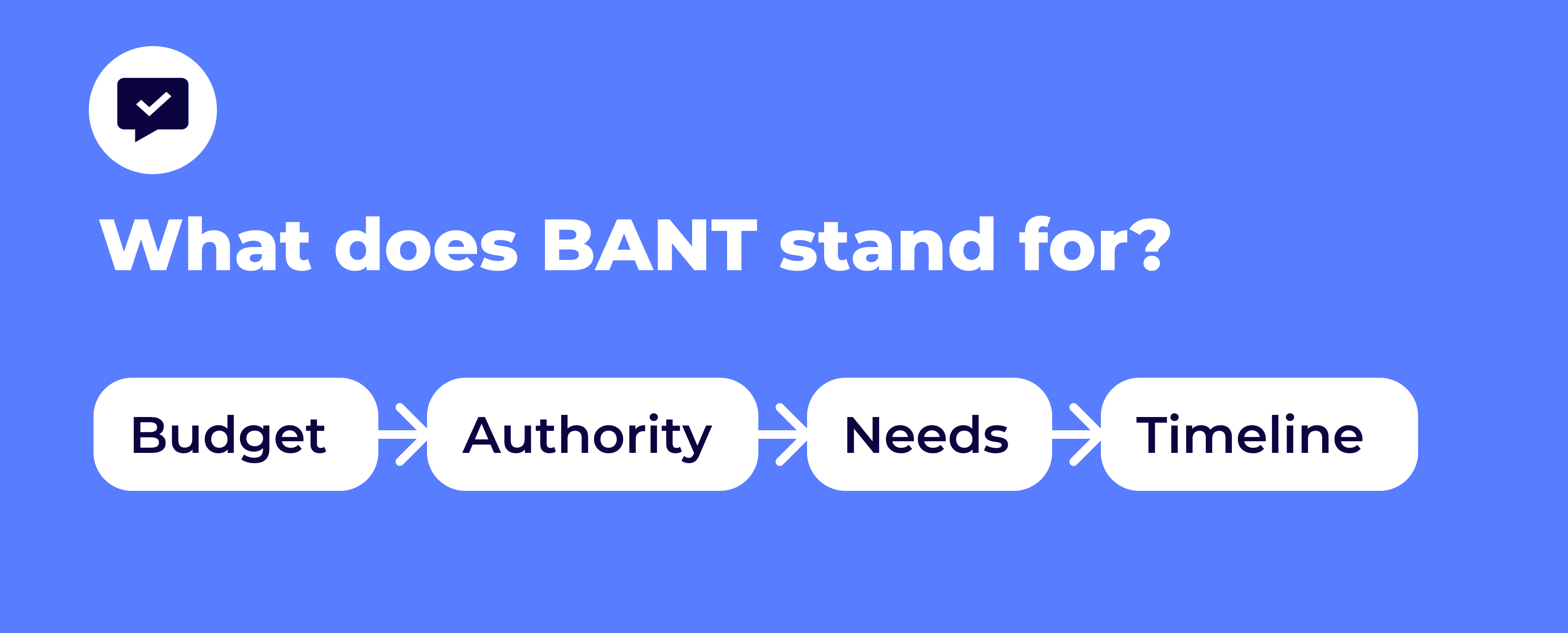
Each of these criteria involves asking various questions according to your company and buyer persona during a call or meeting with the prospect and gathering the necessary data to determine whether or not this lead meets the qualities or requirements you’re looking for.
Below, we explain the 4 criteria of the BANT sales methodology one by one so that you understand what they imply for your teams.
Keep reading!
What’s the deal with Budget?
The first criterion or phase of BANT is the Budget. At this point, you and your teams must evaluate whether a lead has the funds to purchase or hire your company’s products and services.
This phase is summarized in the question, “Can the prospect afford your product?” From there, you can know if your offer fits their expectations and needs.
Does the lead have a fixed budget?
For this phase, it’s crucial to understand how much money a lead is willing to spend and whether that amount works for you and your company.
Here, you should evaluate whether the budget is fixed or if the lead is open to negotiations, even evaluating what you could offer them to make their budget more flexible.
How much has the lead paid before?
In this phase, it’s necessary to evaluate how much the lead has spent before contracting similar products or services.
This can give you a general notion of when the lead is willing to pay and help you understand why the lead decided to change companies if the budget was one of the reasons.
What is the ROI?
When you make offers with other companies, you should both fix how you will measure the value of the investment during your collaboration and what reasonable criteria you will apply to determine whether the joint work was successful.
Who holds the Authority?
The authority phase involves determining whether the person your sales and marketing teams are communicating with is the one who has the authority to decide to buy.
How much influence do they have?
In this phase, your questions should seek to determine whether the lead has the necessary power or influence in the whole buying process and whether they can give you the information once they hear the proposal.
Are they part of a larger team?
Your contact may be only one of several decision-makers, so you must determine their role in the negotiations.
At Reply.io, we suggest you do some research before submitting a proposal or offer. It isn’t enough to talk to the first person who answers the phone; we look for the person who can decide to buy. This prevents you from wasting time and energy presenting your offer repeatedly.
What solution are they looking for?
Talking to the person in charge allows you to understand the company’s needs better. We suggest you consult with those who will use the product because their opinion will undoubtedly be relevant when choosing an option.
Remember that this process isn’t only about closing a sale. The key is always to build loyalty and a relationship between the company and your brand.
How do you figure out Needs?
The third stage of this lead qualification process involves understanding the customer’s needs to determine whether your products can satisfactorily meet them.
What are the weak points?
In this phase, you must use your technical skills to determine if your offer has value for the lead. This involves identifying the company’s pain points, shaping your proposal, and presenting it as a solution.
What are the company’s challenges?
You must discuss the company’s current problems and shortcomings. Understanding this upfront gives you a critical advantage in focusing on potential customers for whom you can provide a viable solution.
How quickly do they need the product or service?
Knowing if the lead needs the product urgently and looking for quick solutions is helpful, which brings us to our next capital letter, “T.”
What’s the Timeline in BANT?
The last criterion, timeline, is linked to the time it will take to achieve sales and get results.
When did the customer’s problem arise?
Determining whether it’s a problem they’ve just detected, or a long-standing problem can help you determine how important it’s for them to find a solution.
If they noticed it recently and are already looking for a solution, this may indicate that the issue is a priority for their business continuity. However, if it’s a long-standing problem and has continued to operate this way, finding a solution may not be relevant.
Do they have a deadline to meet?
If the prospect has a timeline to meet, this means that the purchase is going to happen soon.
When will the customer be able to see the results?
At Reply.io, we know that closing the sale isn’t enough; it’s also important to determine when customers will be able to achieve the expected results.
To do this, you must take into account all the possible challenges of the implementation process, the training, and the learning curve to meet the deadlines. Here are some question you could use.
What questions should you ask for BANT qualification?
Suppose you are ready to take your lead qualification skills to the next level with the BANT method. In that case, it is crucial that you know the most important questions you should ask in your sales process.
Here, we share them with you so that you do not overlook them:
B – Budget
Understanding if they can afford your solution ensures you’re not wasting time on a lead that’s not financially ready.
| Question |
Why It Matters |
| Have you set aside a budget for this project? |
Gauges if money is already allocated or if they’re still exploring options. |
| What’s your typical spending for solutions like this? |
Gives you a benchmark for what they see as a reasonable investment. |
| What happens if this exceeds your budget? |
Reveals flexibility and willingness to stretch for the right solution. |
| Are there financial stakeholders who need to approve this? |
Helps identify who controls the purse strings. |
| How do you usually handle unexpected costs in projects like this? |
Prepares you for potential objections or adjustments in their budget. |
A – Authority
Identifying decision-makers avoids wasted effort on people who can’t close the deal.
| Question |
Why It Matters |
| Who else is involved in decisions like this? |
Uncovers influencers and gatekeepers without being confrontational. |
| What’s your role in the decision-making process? |
Clarifies whether they’re a key player or just gathering information. |
| When decisions like this are made, what’s the typical approval process? |
Maps out the steps needed to close the deal. |
| Would it make sense to include [specific person/department] in our next conversation? |
Opens the door to engaging decision-makers tactfully. |
| Have you implemented similar solutions in the past? If so, how were decisions made then? |
Gives insight into their organization’s decision-making history. |
N – Need
Understanding their pain points ensures your solution is truly a good fit.
| Question |
Why It Matters |
| What’s the biggest challenge you’re trying to solve right now? |
Cuts straight to the core of why they might need your solution. |
| How is this challenge affecting your team/business? |
Helps quantify the problem’s impact and highlights its importance. |
| What solutions have you tried before, and what worked or didn’t? |
Uncovers their preferences and lets you position your product as a better fit. |
| What happens if this problem isn’t solved soon? |
Builds urgency and highlights the cost of inaction. |
| If we could solve [specific issue], how would that help you? |
Frames the conversation positively and focuses on the value you bring. |
T – Timeline
Knowing their urgency helps you prioritize follow-ups and pitch the right solution.
| Question |
Why It Matters |
| When are you hoping to have a solution in place? |
Understands their timeline and matches it to your process. |
| Is there a specific deadline driving this decision? |
Identifies external pressures like launches or compliance requirements. |
| Have you already started evaluating options, or is this an early conversation? |
Gauges how far along they are in the buying process. |
| What’s holding you back from moving forward right now? |
Identifies roadblocks and gives you a chance to address them. |
| If we presented the perfect solution today, when would you be ready to move? |
Sets expectations for next steps and frames the conversation optimistically. |
Make the most of every qualification opportunity to create permanent relationships!



![The Ultimate Email Deliverability Toolset for 2026 [15+ Tools]](https://test.reply.io/wp-content/uploads/deliverability-300x158.jpg "The Ultimate Email Deliverability Toolset for 2026 [15+ Tools]")