Question #22: Personal impact
[If we were to make this deal happen, how would it impact you personally?]
Asking how the changes you’ve discussed will affect them personally is a great way to connect the dots between business goals and individual outcomes. It shifts the focus away from abstract concepts and makes it more real.
For instance, how will solving their company’s problems improve their day-to-day experience, whether it’s in terms of workload, stress, or achieving a personal milestone? By showing them that your solution not only benefits the company but also makes their job easier or more fulfilling, you strengthen the case that they should move forward with you.
Question #23: Past initiatives
[In the past, what initiatives have you tried to solve this issue and reach your goal?]
By asking about the initiatives they’ve tried in the past to solve the issues at hand, you’re learning what they’ve already attempted and what hasn’t worked. This helps you avoid suggesting solutions they’ve already ruled out or tried and failed with.
It’s also a way to acknowledge their efforts and show that you’re not just here to offer another cookie-cutter solution. Instead, you’re tailoring your approach by understanding the limitations of past attempts and offering something more effective, showing them that you’ve done your homework.
Question #24: Required changes
[In your opinion, what changes need to happen to improve the current situation? Do you think your team will be receptive to them?]
When you ask what changes need to happen to improve the current situation, you’re inviting them to be part of the solution process.
People are more likely to buy into a solution if they’ve been involved in the thought process. This question not only helps uncover what they perceive as necessary adjustments, but it also sets the stage for collaboration.
It’s all about showing them that you understand their needs and are prepared to help implement real change, whether that’s new technology, different strategies, or shifts in the company culture.
Question #25: Company objectives
[What general objectives and goals do you have for your company? What about this area in particular?]
This one’s all about getting the big picture.
When you ask about the company’s general objectives, you’re understanding what matters most to them. Maybe their focus is on growth, customer retention, or improving product quality.
Whatever it is, this question shows you’re interested in aligning your solutions with their overall business goals, not just a short-term fix. By connecting the dots between what they want to achieve and how your product or service can support those goals, you ensure that your offering feels like the right fit.
Question #26: Revenue challenges
[What factors are keeping you from reaching your revenue goals?]
Every company struggles with revenue at some point, so when you ask about the factors holding them back from hitting their revenue targets, you’re going straight to the root of the problem. This is where you start talking about the obstacles in their business, whether it’s poor lead generation, ineffective sales strategies, or something else.
By digging into these challenges, you’re in a prime position to highlight how your solution can directly address those pain points, turning barriers into opportunities.
Question #27: Previous role
[What did you do before you worked for this company?]
By asking about their previous role, you’re not only learning more about the person but also gaining insights into their approach to leadership, decision-making, and problem-solving. Someone’s past experience often informs their present decisions.
This question is a way to connect with them on a personal level, while also getting a clearer picture of how they think and what they value. It also provides context for their current priorities, helping you understand where they’re coming from and how best to approach their needs.
Question #28: Industry change
[Since (industry event,) how have things changed in your company?]
When you bring up an industry event and how it’s impacted their company, you’re acknowledging the dynamic nature of their business environment. Industries are constantly shifting, and change often triggers new opportunities or challenges.
By asking about it, you show that you’re aware of the bigger picture and how external factors are affecting them. This question is great for identifying new needs that have come up as a result of these shifts, helping you position your solution in light of recent developments.
Question #29: Company values
[I noticed that instead of hanging your values on the wall like other businesses, you have notes from your employees saying what your company’s values mean to them. What made you do that instead? What did the responses teach you about your team and the company as a whole?]
This is one of those questions that helps you understand the deeper motivations behind a company’s culture. When you ask about values, you’re not just talking about mission statements on a wall; you’re exploring what the company genuinely stands for.
Maybe it’s transparency, teamwork, or innovation. This insight helps you figure out how to communicate your solution in a way that resonates with their core beliefs.
If you can show that your product or service aligns with their values, it becomes much easier to make a compelling case for why they should work with you.
Question #30: Service appeal
[When considering our services/ products, what about them do you find most appealing? How do you think it will improve your business?]
When you ask what about your product or service they find most appealing, you’re getting direct feedback on what’s driving their interest. Is it the features, the customer support, the pricing, or something else? Understanding this helps you highlight the aspects of your offering that matter most to them, tailoring your pitch to what they value.
It’s also a great way to pinpoint what might be missing or could be improved to better meet their needs. You’re learning about their priorities in real-time, which gives you a competitive edge in the conversation.
Question #31: Decision makers
[When it comes to the decision-making process with this purchase, who is involved? Do you need to get authorization?]
When you ask who is involved in the decision-making process, you’re getting a clear picture of the stakeholders in the room.
It’s not just about knowing who you need to talk to now, but also understanding how decisions are made within the company. Sometimes it’s the CEO, other times it’s a cross-functional team or a committee.
The beauty of this question is that it allows you to tailor your approach to the specific decision-makers. If you know who holds the purse strings or who will be most impacted by your solution, you can present your offering in the best light possible for them.
Question #32: Workflow improvements
[What are some examples of how our product/ service would improve your daily workflow?]
When you ask how your service or product would improve their daily workflow, you’re diving into the practical, everyday benefits of your solution.
Business owners and managers are often juggling a lot of moving parts, so showing them how your offering can streamline their operations or make their teams more efficient is a big win.
It’s not about theoretical advantages, but real, tangible changes that make life easier for the people actually doing the work. This question helps you make the case that your solution isn’t just another tool, but something that makes their day-to-day operations run smoother.
Question #33: Investment willingness
[When thinking about the main pain points your company is facing, what are the factors that would influence how willing you are to invest in a solution?]
This one goes straight to the heart of the buying decision. When you ask what factors would influence their willingness to invest in a solution, you’re uncovering what they truly value and what might make them hesitant to move forward.
This could range from cost to expected ROI, to how confident they feel about the product’s ability to solve their pain points. Knowing this allows you to address objections up front, making it easier to move the conversation toward closing the deal.
You’re also learning what kind of financial commitment they’re comfortable with, which helps you tailor the offer to their budget.
Question #34: Pricing alignment
[How does our pricing align with your budget? What could we do to make our product/ service an even better value?]
By asking how your pricing aligns with their budget, you’re making sure you’re not wasting anyone’s time. If they can’t afford the solution or feel that it’s too expensive for the value they’re getting, it’s better to know that early.
This question helps you understand if there are any financial concerns, and more importantly, it opens the door to discussing alternatives. Maybe you can offer a payment plan, or maybe there are adjustments to your offering that would make it a better fit.
Either way, getting the financial conversation out in the open ensures you’re not blind-sided by price objections later on.
Question #35: Essential features
[What features in our product/ service are essential for improving your business?]
When you ask what features are essential for improving their business, you’re narrowing the focus to what really matters. Sure, your product might have a lot of great features, but not all of them are going to be important to every client.
This question helps you zero in on the aspects of your service that will have the most immediate impact on their business. By focusing on the essentials, you avoid overwhelming them with unnecessary details and make it easier for them to see the value in what you’re offering.
It’s all about making your solution as relevant and tailored to their needs as possible.
As you can see, open-ended questions for sales can encompass numerous topics related to the business and the buyer’s personal life. Using a mixture of both lets you build a connection while gaining valuable insights into their needs.
Feel free to customize the questions to fit your products or services and to match with the buyer.
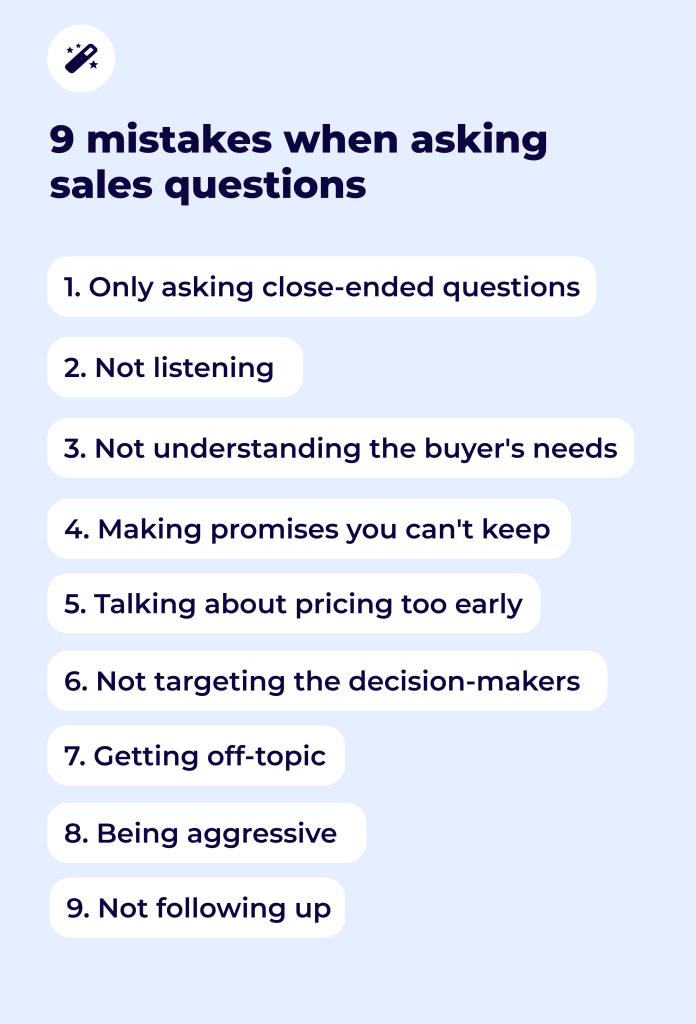
What to avoid: 9 mistakes when asking sales questions
You’ve been there; you’re speaking with a potential buyer, and everything’s going great. All of a sudden, they either shut down or seem less responsive. Maybe you notice a shift in the conversation, or when it comes to closing the deal, they decide to go in another direction.
While there’s plenty of reasons these scenarios can occur, it often has something to do with your question and answer interactions.
We get it; there’s nothing worse than putting in the effort with a buyer only to have the sale fall through. To help you avoid this frustrating scenario, we came up with ten common mistakes you should avoid when asking sales questions.
Mistake #1 – Only asking close-ended questions
As we discussed earlier, when used together, open and close-ended sales questions give you an in-depth look into the mind of the buyer. However, only asking closed questions makes it easy for them to walk away since you never build a true connection.
Remember, close-ended questions only require a “yes” or “no” answer, which is great for data collection but less than ideal when you’re trying to keep the buyer engaged.
Using a healthy mix of both open and close-ended questions will provide the insights you need while developing trust and opening communication.
Mistake #2 – Not listening
Active listening skills are a crucial part of any successful marketing strategy. When trying to make a sale, it’s easy to talk—a lot, especially when you’re passionate about your products or services.
However, if you don’t take the time to listen to the buyer, or worse, interrupt them when they’re speaking, you could do more harm than good.
When you take the time to truly listen to what the buyer says, your job gets easier. They’ll do the hard work for you, telling you their pain points and what they believe would solve them. From there, all you have to do is connect the dots and show them how your products or services can improve their life and make their business more successful.
Mistake #3 – Not understanding the buyer’s needs
Too often in sales, we fail to fully understand the buyer’s needs, and it can be a costly mistake. Using open-ended questions is a great way to gather the insights necessary to gain a comprehensive understanding of their pain points and what it will take to solve them.
Don’t rush the process; take time to ask questions and contemplate the answers. The better you can comprehend the buyer’s problems, the easier it is to provide the solutions.
Mistake #4 – Making promises you can’t keep
If you want your business to be successful, one of the most important things you can do is forget about how much you can make from a sale and place your focus on how you can help the buyer.
Think about it; if you’re considering purchasing a product and the salesperson is pushy or overpromises, how does it make you feel? Do you think they care about you as a customer or simply want your money?
You never want a buyer to feel that way about you or your business, which is why it’s important to never make promises your product or service can’t deliver. The buyer will respect and appreciate your honesty, making you more likely to close the deal.
Mistake #5 – Talking about pricing too early
This mistake goes along the lines of the previous one. You never want the buyer to think you only care about turning a profit; it makes your business seem greedy and leads them to question the authenticity of your offerings.
Don’t rush the sale; instead, take time to learn about the buyer and allow pricing to come up naturally in the conversation.
When you focus on showcasing your value and how you can improve the buyer’s life, they’ll care less about what your products or services cost and more about how they believe it will provide a solution to their problems.
Mistake #6 – Not targeting the decision-makers
Every business has specified employees who make the financial decisions. It’s essential that you make sure you’re targeting the executives with purchasing power and not trying to sell to just anyone.
Before you invest your time, be sure to ask who has the authorization to make purchases and reach out to them directly. You don’t want to spend considerable time speaking with someone only to find out they don’t have permission to close the deal.




![The Ultimate Email Deliverability Toolset for 2026 [15+ Tools]](https://test.reply.io/wp-content/uploads/deliverability-300x158.jpg "The Ultimate Email Deliverability Toolset for 2026 [15+ Tools]")