VanillaSoft → sales cadence tool with AI-powered routing
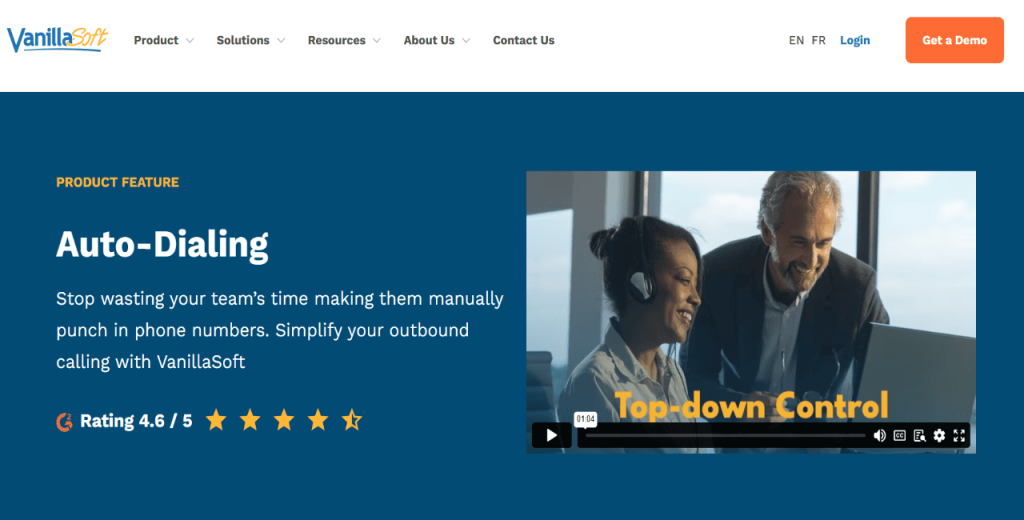
VanillaSoft combines auto-dialing with sales cadence management to help users progress through leads more efficiently and with fewer distractions.
It supports two dialing modes, Progressive and Preview. Progressive automatically dials the next contact when a rep finishes their current call. On the other hand, Preview lets sales representatives review contact details before dialing manually with a single click.
VanillaSoft also offers queue-based lead management.
The system automatically routes leads to the next available representative based on preset rules, such as time zone, status, or lead priority. That way, VanillaSoft removes decision-making from the rep’s hands and, by extension, ensures outreach is focused and consistent.
When paired with the AI dialer, this structure helps teams increase call activity, with some users reporting increases of up to 296% compared to manual dialing benchmarks.
Additionally, you can use the dialer within the broader VanillaSoft platform, which allows you to access features such as voicemail drop, SMS messaging, and external phone setups, including desk phones and softphones.
VanillaSoft pros:
- Smart lead routing
- Auto and manual dialing
- Voicemail drop and SMS included
VanillaSoft cons:
- No AI coaching
- Some users say the interface is dated
VanillaSoft pricing:
VanillaSoft pricing isn’t publicly available. Contact their team for a custom quote.
NICE CXone → enterprise-ready with predictive AI capabilities
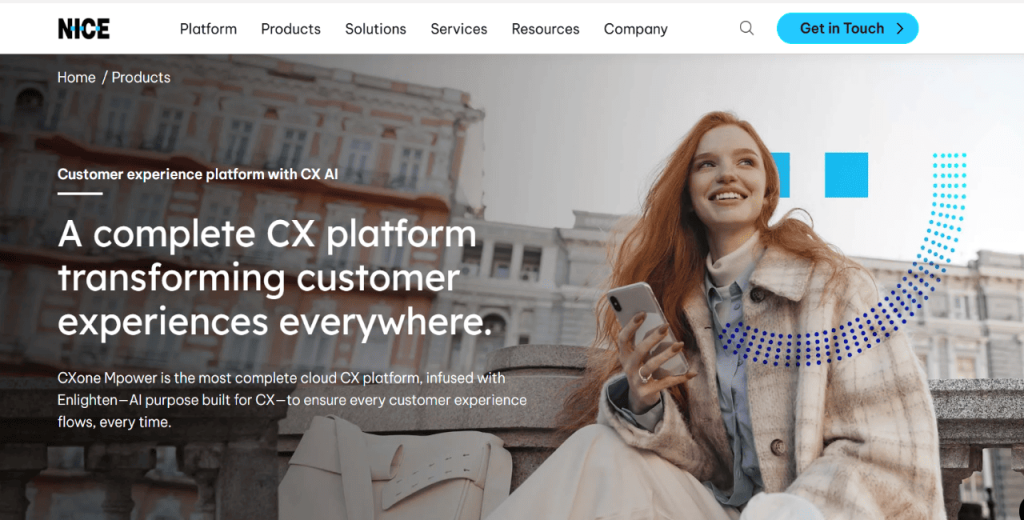
NICE CXone’s AI dialer uses predictive dialing to reach more contacts faster by analyzing agent availability, pacing algorithms, and historical response patterns.
The dialer’s standout feature is predictive behavioral routing. The function matches each contact with the most appropriate agent based on past behavior, sentiment, and profile data.
Predictive behavioral routing improves first-call resolution and boosts customer satisfaction. Additionally, the dialer integrates with real-time speech analytics to monitor call quality in real-time, enabling dynamic adjustments.
For enterprise-level operations, CXone has inbound and outbound campaigns, compliance controls, and easy CRM integration.
It enables large teams to monitor performance across regions while still tailoring workflows to each campaign. With everything running through a centralized AI engine, NICE CXone delivers advanced automation for high-volume outreach.
NICE CXone pros:
- Real-time speech analytics
- Ideal for large-scale outbound operations
NICE CXone cons:
- Steep learning curve
- Requires enterprise-level setup
NICE CXone pricing:
Nice CXone doesn’t list its pricing on the website. You’ll need to contact the platform’s sales team for pricing.
AI makes cold calling faster, smarter, and more consistent. It eliminates guesswork, shortens idle time, and helps sales reps concentrate on live conversations. When used well, it turns repetitive outreach into a structured, data-driven process.
That said, here’s how AI improves cold calling performance across different stages of a sales call:
It filters out wasted calls
Every cold calling list has its share of bad numbers, voicemails, and endless rings.
AI dialers help reps avoid this by detecting non-human responses and automatically skipping over them.
In addition, Al ensures that your reps are only connected when a real person answers, which can result in more conversations in the same amount of time.
It helps reps respond better
Sure, speed is critical when it comes to cold calling. However, quality is equally essential.
Besides helping users connect with real humans, AI also supports them during live conversations. It offers real-time prompts, suggesting what a rep needs to say based on the conversation.
These can be product facts, common objection replies, or compliance reminders. With AI-powered cold calling, sales reps and SDRs don’t have to memorize everything; they just need to focus on the person in front of them.
It chooses the right moment to call
Cold call timing can significantly impact your chances of closing a sale.
AI learns from past call patterns and recommends or automatically adjusts when calls go out. If most people answer between 10 and 11 AM, for instance, the dialer prioritizes that window.
It also picks the best number when multiple options exist for a lead. These minor adjustments often lead to higher pickup rates.
It turns conversations into usable data
AI captures every word and converts calls into searchable transcripts.
It can also generate summaries and tags for critical moments, such as when a price is discussed or a competitor is mentioned. This makes it easy to go back and learn from past calls without having to listen to every second.
Over time, it also helps teams identify what consistently works.
It removes time-consuming admin work
After every call, reps usually have to log notes, update the CRM, and prep for the next task. AI can handle this automatically.
It records outcomes, attaches summaries to the contact profile, and triggers the next steps, such as scheduling a follow-up or assigning a tag.
It creates a consistent process for everyone
Sales performance varies widely across representatives. AI dialers help reduce that gap by providing the same structure and support to everyone on the team.
New hires don’t have to figure things out from scratch. On the other hand, experienced representatives stay aligned with current messaging and processes. This leads to more predictable performance and easier coaching.
What are the risks or limitations to consider?
AI dialers have revolutionized cold calling. Granted.
However, they come with their fair share of challenges. You need, therefore, to be aware of the limitations of AI-powered cold calling that may affect efficiency, compliance, or customer experience.
Data privacy concerns
AI dialers must adhere to strict guidelines for consumer outreach. Regulations like the TCPA in the U.S. and GDPR in Europe set boundaries on how and when you can contact leads.
Some AI systems may not automatically account for updates to these laws or properly manage Do Not Call lists.
If left unchecked, this can result in regulatory fines or reputational damage. Therefore, your team still needs to monitor how their dialer handles consent, call recording, and opt-outs.
Over-automation
When you rely too heavily on AI-generated prompts or scripting, conversations can start to feel robotic. While automation helps with consistency, it can reduce a representative’s ability to adapt in real time or build rapport.
This is especially true when dealing with objections or nuanced sales discussions. Besides, reps need the flexibility to break from the script and respond naturally, something not every AI dialler supports well.
Integration issues
Some AI dialers don’t sync well with CRMs or sales engagement platforms. If call data isn’t logged automatically or mapped correctly, reps are left doing manual updates or switching between systems.
This increases the risk of errors and slows down follow-ups. Furthermore, integrations that only cover part of the sales process often lead to disconnected workflows and missed opportunities.
High setup and steep learning curves
Enterprise-level dialers often feature complex functionalities and intricate setup requirements. And, training reps to use AI tools effectively takes time, especially when introducing new prompts, analytics dashboards, or routing rules. Without a clear onboarding process, representatives may default to old habits, limiting the tool’s impact.
Limited multichannel outreach
Most AI dialers are built around voice-only communication. While this works well for phone outreach, it doesn’t entirely reflect how modern buyers engage.
However, this single-channel limitation can hinder outreach efforts in an increasingly multichannel world. The good news is, you can use Jason AI SDR to power your multichannel outreach.
Jason uses AI to automate outreach across email, LinkedIn, and SMS. It personalizes messages, schedules follow-ups, and even books meetings, allowing your team to reach prospects on their preferred channel faster.
Jason, combined with AI dialers, gives sales reps more touchpoints, higher response rates, and a fully coordinated outbound workflow.
Final thoughts
That’s it.
You now know which the best AI dialers are and what makes them unique.
The choice of one AI dialer primarily depends on your cold calling needs. It is worth mentioning, however, that while each tool has its strengths, they drop the ball when it comes to multichannel coordination.
For a truly well-rounded outbound strategy, you need more than just fast dialing.
You’re better off with Jason AI SDR in your corner, helping you run a synchronized outreach across voice, email, LinkedIn, and SMS.
And because Jason is built into the Relpy.io ecosystem, you can also add other tools like the email deliverability kit to ensure your messages reach your prospect’s inbox.
Want to see Jason AI SDR in action? Book a demo!





![The Ultimate Email Deliverability Toolset for 2026 [15+ Tools]](https://test.reply.io/wp-content/uploads/deliverability-300x158.jpg "The Ultimate Email Deliverability Toolset for 2026 [15+ Tools]")