Which channels and sales models fit your product and customers best?
You can’t pick a channel or sales model just because it worked for someone else.
The right approach depends on your product complexity, who you’re selling to, and how long your sales cycle runs.
In this section, we’ll look at how to build a mix that fits your GTM strategy. Here’s how to go about it.
Match your sales model to buying behavior
Your sales model should reflect how customers buy your product, not how you want to sell it. The more complex your product or purchase process, the more involved your sales model needs to be.
Let’s unpack that.
- Use direct enterprise sales when you’re dealing with large contracts, complex onboarding, or multiple stakeholders.
- Lean toward inside sales if you serve mid-market customers with medium complexity.
- Opt for product-led growth (PLG) if users can self-serve and discover value quickly.
- Explore partner or reseller models for hard-to-reach or localized segments.
The goal is to reduce friction and meet buyers where they are.
Combine channels into one cohesive strategy
An effective B2B SaaS GTM strategy doesn’t rely on a single channel.
It combines inbound, outbound, and account-based tactics into a cohesive approach. Think of your strategy as a system where each channel plays a role at different funnel stages.
Below are some combinations you can consider:
- Inbound marketing with content, SEO, and webinars
- Outbound prospecting with SDR outreach, email, and social
- ABM campaigns with tailored engagement for high-value accounts
- PLG (product-led growth) with free trials, freemium tiers
- Partner channels with affiliates, marketplaces, and resellers
Whatever combination you use, balance automation with human interaction.
For example, self-serve onboarding is great. However, you can pair SDR outreach and customer success check-ins to improve conversion and retention.
Tap into social media and communities
Buyers don’t just depend on search or ads to find products they’re looking for. They also ask peers in Slack groups, niche communities, LinkedIn threads, even Reddit.
Use social listening tools like Brandwatch and Sprout Social to monitor conversations and engage in these informal yet powerful influence spaces.
How should you price and package your SaaS product?
Pricing is a positioning strategy. Done right, it aligns with how your customers use and value your product. Therefore, price and package your product thoughtfully.
Here’s how to get it right from the get-go.
Use pricing models that fit usage behavior
Subscription pricing is the most common SaaS model. However, differentiation boils down to how you structure your tiers. That said, you can build plans around:
- Feature access
- Number of users
- Value metrics like data volume, API calls, or contacts
For high-usage or variable-demand customers, consider metered billing. For starters, this is a pay-as-you-go model that scales with usage.
Metered billing also helps lower the barrier to entry, especially for budget-conscious segments.
Reduce friction with freemium and trials
Freemium and free trials can accelerate adoption and top-of-funnel growth. However, you must package them strategically.
Here, you’ll want to ensure you offer just enough value to allow users to experience results. More importantly, you should clearly define what’s gated behind paid tiers.
When using free trials:
- Keep them short (7–14 days) to create urgency
- Pair with onboarding emails and feature prompts
- Track conversion events and drop-off points for optimization
Support high-touch deals with pilots and enterprise pricing
If you sell into large organizations, you’ll need custom pricing.
Offer pilot programs that demonstrate value before full rollout. You can use these pilots as a wedge for upselling into broader deployments.
Be sure to bundle premium features, support, and integrations into your enterprise packages. You can also include add-ons to create natural upsell paths and improve retention.
Test, measure, and refine pricing
Pricing shouldn’t be static. Therefore, use customer feedback, A/B tests, and usage data to experiment and refine.
The Van Westendorp price sensitivity meter can help you understand perceived value ranges. Meanwhile, you can use tools like ProfitWell, Chargebee, and Stripe to manage billing, analytics, and pricing logic.
How can you drive customer success and reduce churn?
Acquiring B2B SaaS customers is one thing. But retaining them is entirely different. Your SaaS GTM strategy, therefore, shouldn’t end at acquisition.
To drive sustainable revenue, you must invest in customer success and reduce churn at every stage of the lifecycle.
Here’s how to build a customer success engine that fuels retention, expansion, and advocacy.
Monitor customer health proactively
Retention starts by identifying your best customers and those who could drop off. Once you’ve done that, build a customer health score that includes the following multiple data points:
- Product usage: Consider the frequency, depth, and breadth of feature adoption
- Engagement metrics: Check the login frequency, team usage trends
- Support activity: Analyze the volume and type of tickets submitted
- Net Promoter Score (NPS) scores and qualitative feedback
You can use platforms like Gainsight and Totango to automate health scoring and trigger playbooks for at-risk accounts or upsell-ready customers.
Build continuous feedback loops
Customer needs change, so your GTM strategy should evolve too. Therefore, develop structured feedback loops to capture real-time insights and identify friction early.
Start with a quarterly NPS program to track sentiment over time. Use tools like Delighted or AskNicely to automate survey distribution, collect feedback, and trigger follow-ups based on score segments.
In addition, gather features to help you prioritize your roadmap based on actual user needs.
You should also run customer satisfaction (CSAT) surveys after key touchpoints. That way, you can pinpoint moments of delight or frustration across the journey.
Educate customers to drive value
Customers who derive value from your product are less likely to churn.
Therefore, education should be central to your customer success strategy. Invest in scalable, self-service resources, such as live or on-demand webinars.
You can also consider detailed product documentation and how-to videos.
Add active user communities to enable peer support. These initiatives reinforce onboarding, accelerate feature adoption, and empower users without overwhelming your customer success team.
Align success with revenue opportunities
Customer success is good for retention. However, you should also leverage it for growth. For example:
- If a customer highly engages with a feature engagement, recommend premium add-ons.
- If they’re nearing user limits, trigger upgrade campaigns.
- If they’re barely using a feature, assign a CSM for reactivation support.
This approach allows you to use customer success to drive satisfaction and lifetime value.
Turn happy users into advocates
Existing customers are your best growth channel.
So, build an advocacy program that incentivizes referrals, testimonials, and case studies. In addition, offer early access to features or discounts in return for social proof.
Brand advocates can help lower customer acquisition cost CAC and at the same time boost trust across the funnel.
Ongoing communication
Many companies work so hard on getting leads through the door, but then forget to keep engaging with them after they become paid customers.
Given that in B2B SaaS it’s customer retention that’s one of the main driving forces of success, it’s equally important to have custom outreach sequences for general product updates, upcoming events, cross-selling and up-selling, and feedback gathering.
Creating a few post-purchase campaigns is just as easy with Jason AI — you simply tell its AI engine the purpose of each new sequence, and it will handle choosing the right customers to add, as well as the right timing and messaging to use.
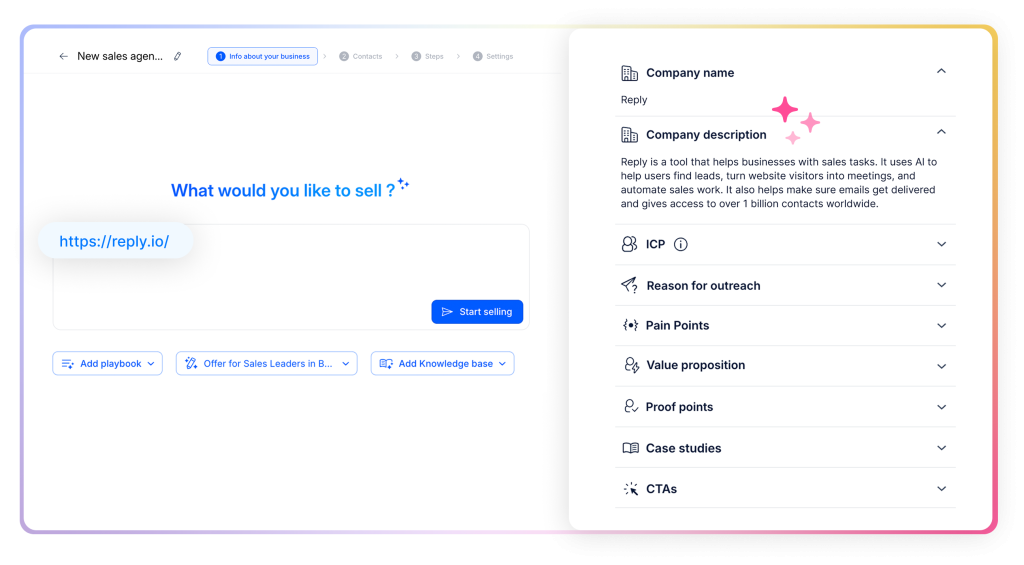 This kind of communication keeps customers feeling valued and more likely to renew their subscription when the time comes.



![The Ultimate Email Deliverability Toolset for 2026 [15+ Tools]](https://test.reply.io/wp-content/uploads/deliverability-300x158.jpg "The Ultimate Email Deliverability Toolset for 2026 [15+ Tools]")